Your Flight Controller Buying Guide: How to Make the Right Choice
So, you’re building an FPV drone. The flight controller (FC) is its brain, and your choice will define your drone’s performance, smoothness, and capability. With so many options, how do you choose? Forget the confusion. This guide will walk you through the three critical decisions you need to make.
1. The Processor: F4 vs. F7 – It’s About Headroom
The processor (MCU) determines how much data your FC can handle.
- F4 FCs: A proven and cost-effective workhorse. Sufficient for most pilots running standard Betaflight setups. However, it has limited processing headroom. If you want to run high loop rates (8kHz+) and complex filtering without overloading, you’ll hit its limits.
- F7 FCs: The new standard for performance. An F7 processor offers significantly more power, allowing for faster loop rates, more advanced filtering algorithms, and future-proof features. Our recommendation: For any serious build, an F7 is the smart choice. It ensures a smooth, responsive feel and room to grow as your skills advance.
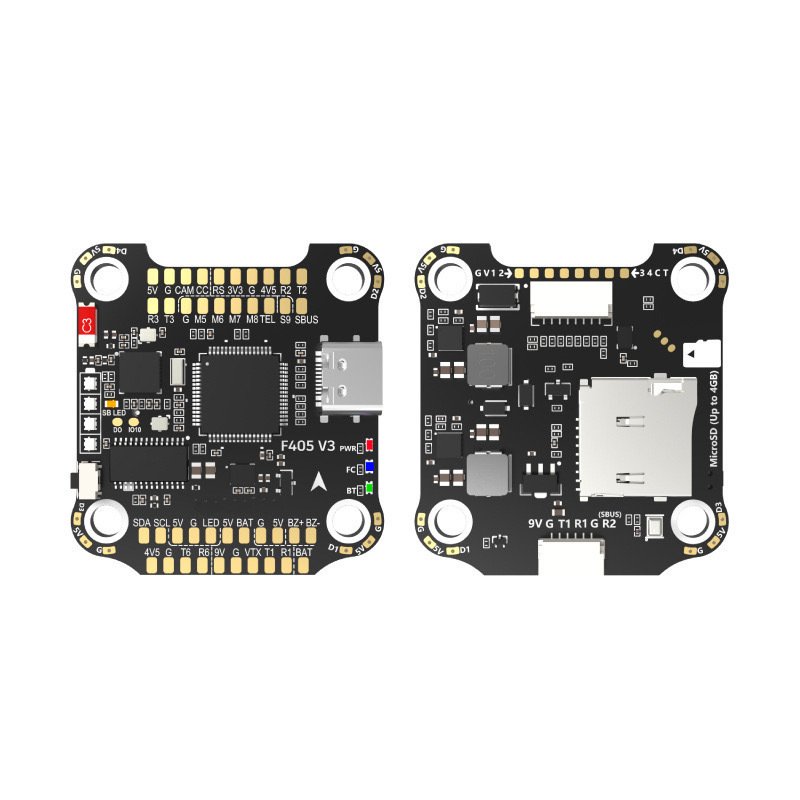
2. The Form Factor: Will It Fit Your Frame?
This is about physical compatibility. Check your frame’s mounting hole pattern.
- 30.5×30.5mm: The standard for many 5″ and larger drones. Offers plenty of space for components.
- 20x20mm: Common in smaller, lightweight builds (3-4″) and micro drones. Compact and light.
- Whoop Boards (AIO): All-In-One boards that integrate the FC, ESCs, and often a VTX for the smallest builds.
3. The Feature Set: Matching Your Needs
Look beyond the chip. Your flying style dictates the features you need.
- The Gyro: This is your FC’s sense of balance. Look for modern, low-noise gyros like the BMI270 or ICM-42688-P for the cleanest signal, which is the foundation of a smooth-flying drone.
- Barometer & Compass: Essential for GPS rescue and autonomous flight modes. If you plan on long-range flying, these are non-negotiable.
- UARTs: These are your communication ports. Count how many you need: one for your receiver (ELRS, Crossfire), one for a GPS module, and potentially one for a Smart Audio/TRAMP VTX. More UARTs mean more flexibility.
- Blackbox Logging: Crucial for troubleshooting and advanced tuning. Ensure the FC has enough onboard storage or an SD card slot.
To Summarise:
- For Beginners/Racing on a Budget: A reliable F4 FC with a good gyro is a solid start.
- For Enthusiasts, Racers, and Freestylers: Invest in an F7 FC. The performance headroom and smoother flight are immediately noticeable.
- For Long-Range & Cinematic Pilots: Choose an F7 FC with multiple UARTs, a barometer, and a reliable, low-noise gyro.
By focusing on Processor, Form Factor, and Features, you can confidently select a flight controller that perfectly matches your drone and your ambitions.